
Deck the Malls: The (Out-Of-) Home Of Festive Spirit
New audience behaviour insights fro Christmas 2026

Christmas shopping is changing. It starts earlier, happens more frequently and increasingly blends shopping with food, entertainment, socialising and experiences.
Our latest research into the behaviour of mall audiences around Christmas 2026 reveals a particularly valuable audience for retailers and brands. Mallgoers are more likely than the national average to make multiple festive shopping trips, spend more, shop spontaneously and respond positively to impactful brand experiences.
And importantly, their relationship with the mall doesn’t end when Christmas does. From Boxing Day sales through January promotions, dining, cinema, entertainment and new-season shopping, malls remain a destination well into the New Year.
The findings point to a simple conclusion: Christmas is not one shopping moment. For mall audiences, it is a prolonged period of discovery, spending and experience.
Christmas Stars Earlier
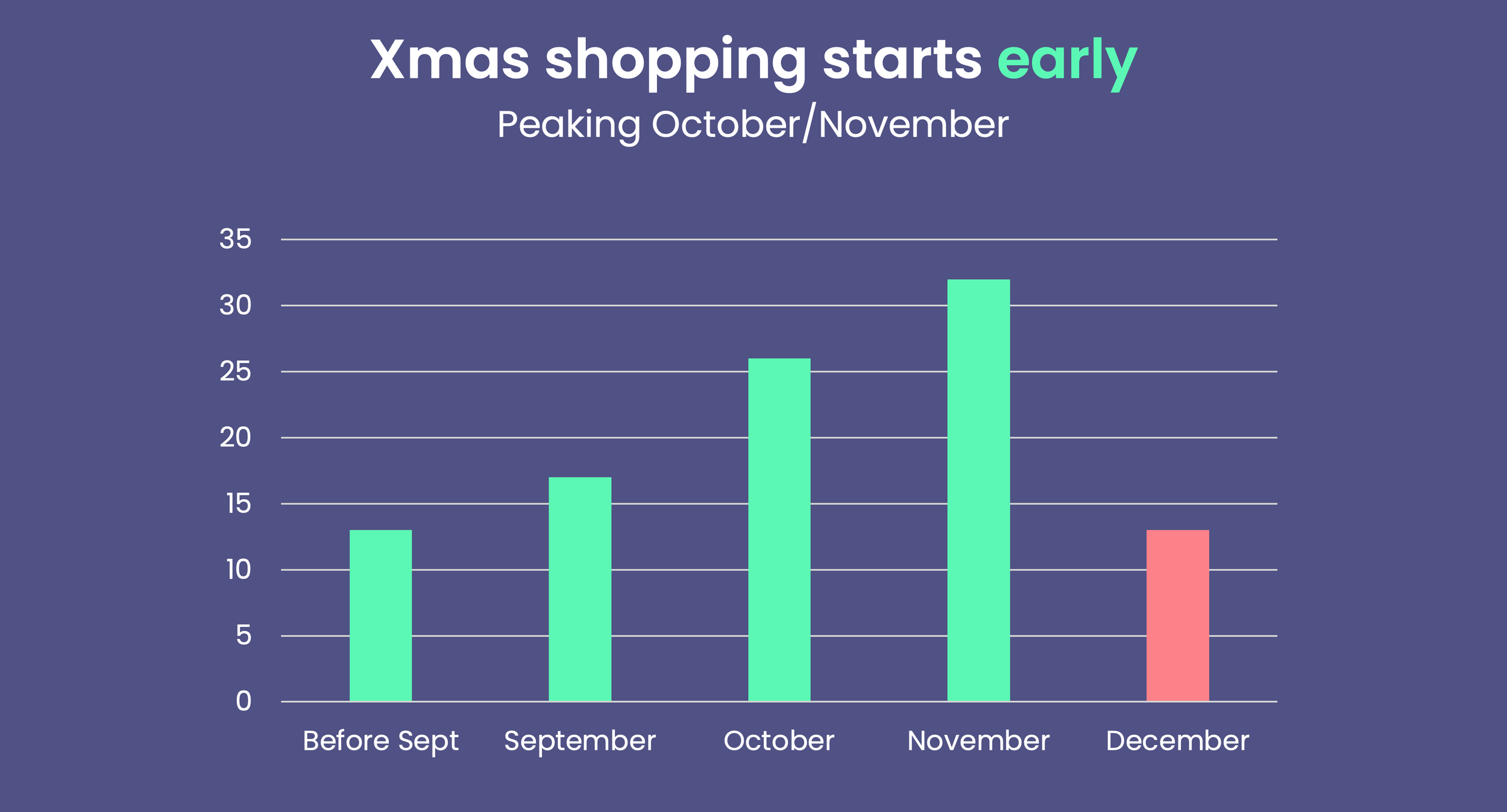
For mall audiences, Christmas shopping begins well before December, with 26% starting their Christmas shopping in October and a further 32% in November.
This early start is consistent with the wider direction of travel among UK consumers. PwC’s 2026 Consumer Sentiment Survey found that 14% of consumers had already started their Christmas shopping by mid-August, while a further 16% planned to start earlier than usual. One in four consumers also expected to spend more on Christmas shopping and celebrations than the previous year.
This means the traditional idea of a December-only Christmas campaign is becoming increasingly outdated. Brands have an opportunity to build awareness and consideration from the beginning of autumn, before the busiest shopping period arrives.
And for malls, early Christmas activity is particularly important because the audience isn’t simply visiting once.
More trips. More spending. More opportunities.
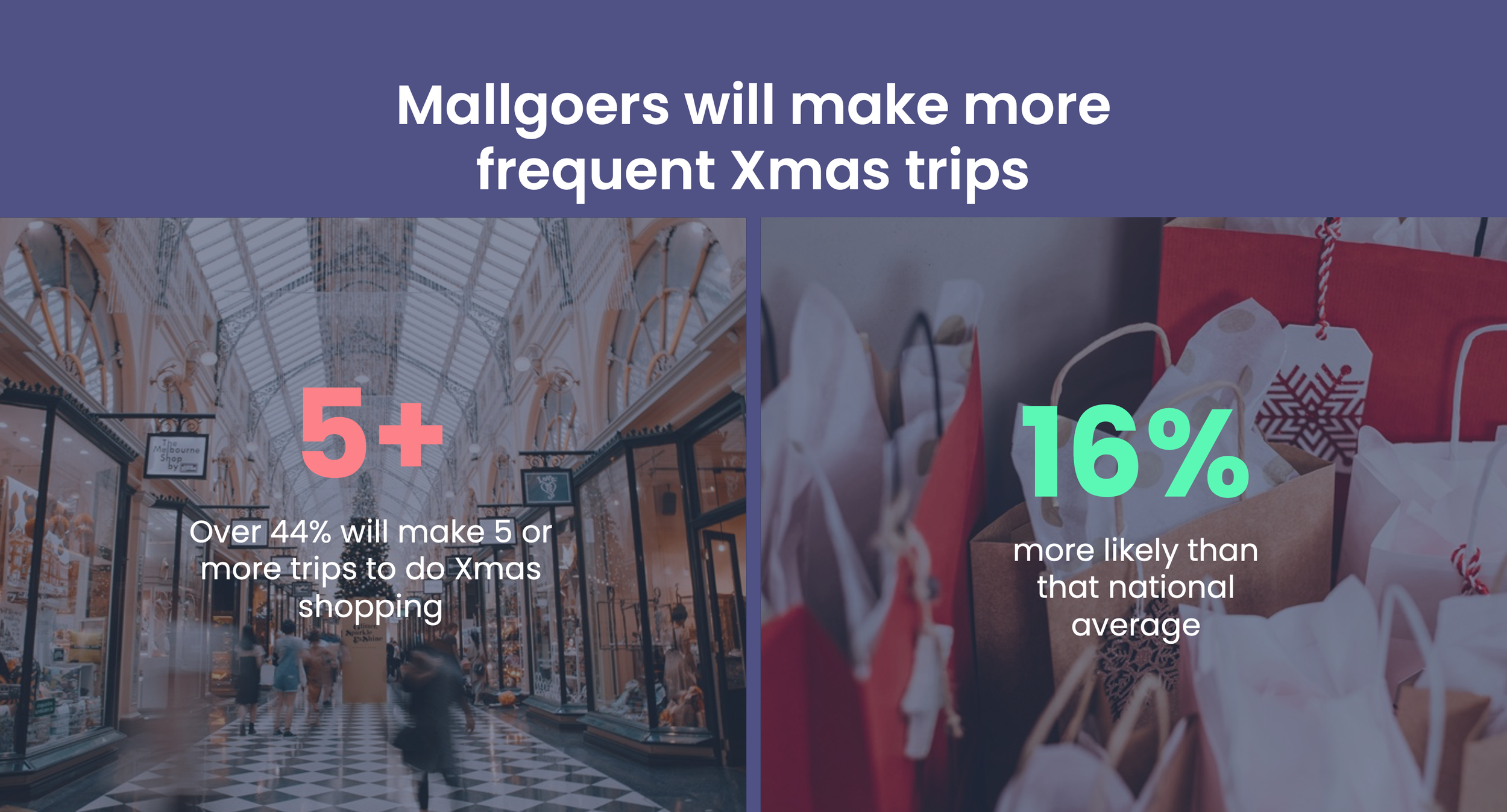
More than 44% of mallgoers expect to make five or more Christmas shopping trips, making them 16% more likely to do so than the national average.
These aren’t simply additional visits. They represent additional opportunities for discovery, impulse purchases, brand engagement and experiences.
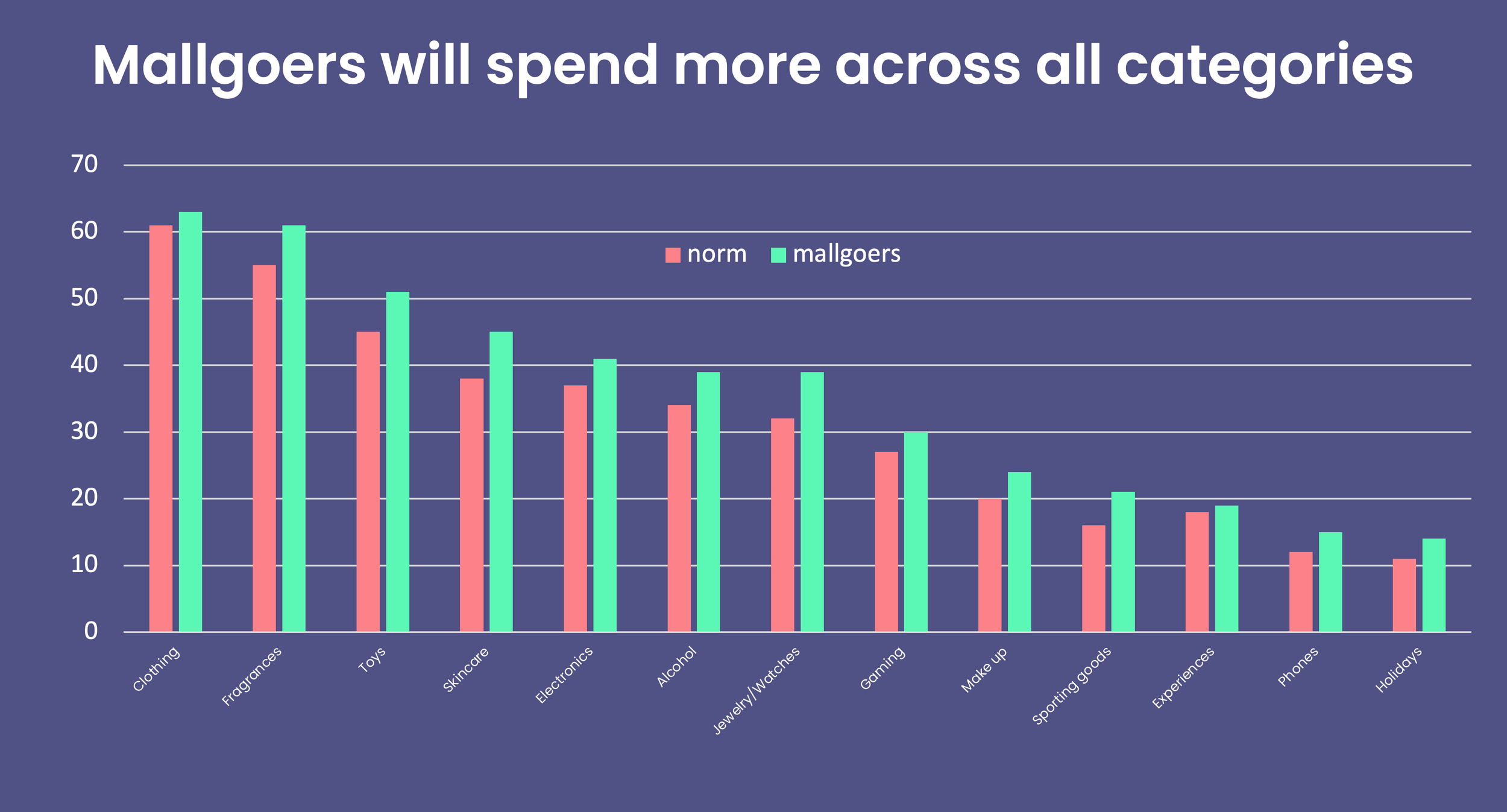
Mallgoers are also more valuable from a spending perspective. Almost half, 46%, expect to spend £500 or more on Christmas shopping, making them 12% more likely to reach this level of spend than the national norm. They are also 30% more likely to say they will spend more this Christmas than last year.
That increased spending is spread across a broad range of categories, with particularly notable increases in skincare and jewellery and watches, both up seven percentage points, followed by fragrances and toys, both up six points. Alcohol and sporting goods also see increases of five percentage points.
The scale of spending is notable when set against the wider market. YouGov’s Christmas research found a median estimated total Christmas spend of £550 when gifts, food and drink, travel, social events and other outings were considered. PwC has also highlighted continued consumer willingness to spend on maintaining the quality and experience of Christmas, despite wider household financial pressures.
Our findings suggest that mall audiences sit towards the more valuable end of this Christmas spending spectrum - and that they are particularly receptive to categories that lend themselves to browsing, discovery and gifting.
The impulse opportunity
Christmas isn’t just about planned purchases.
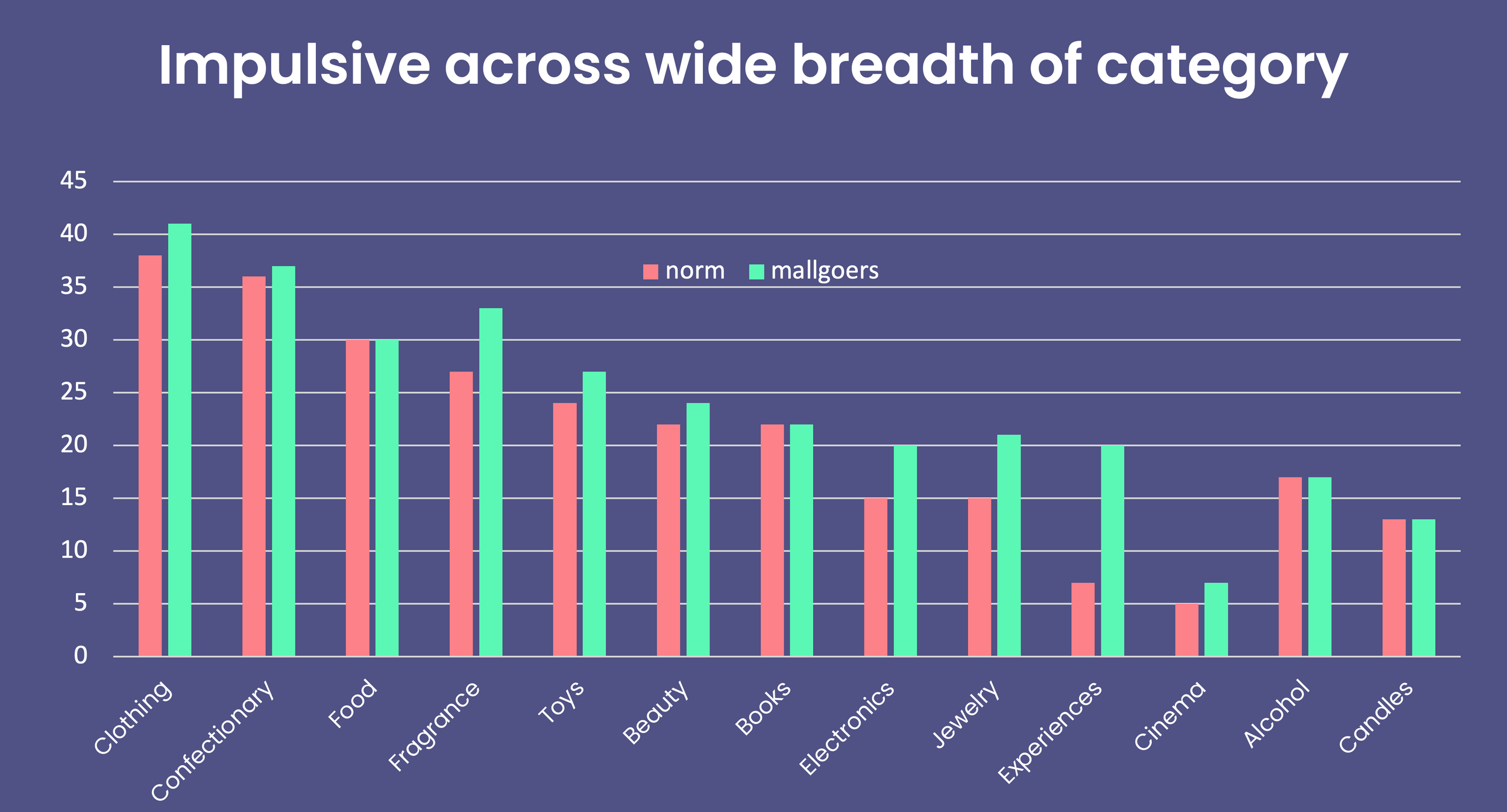
A striking 77% of mallgoers describe themselves as impulsive Christmas shoppers. A quarter say they willing to spend £100 or more on an impulse Christmas purchase, making them 39% more likely to do so than the national average.
The categories where this spontaneous spending is particularly strong are revealing. Experiences see the biggest increase, at 13 percentage points over the national norm, followed by fragrance and jewellery at six points each. Electronics rise by five percentage points, while clothing and toys are both up three points.
This is where the physical environment can make a real difference.
Online shopping is increasingly effective at facilitating planned purchases, but the mall can create the conditions for something different: the unexpected purchase.
A striking display, an immersive activation, a seasonal experience or simply seeing a product in real life can turn consideration into action.
That distinction matters at Christmas, when audiences are already in a purchasing mindset.
Why the mall wins at Christmas
So what brings people into malls during the festive period?
The answer is convenience, choice and atmosphere, often working together.
For 54% of mallgoers, the biggest appeal is having “everything under one roof”. Almost half, 46%, value protection against bad weather, while the same proportion cite the wider range of shops. Longer opening hours are important to 30%, while 27% value the choice of restaurants and cafés.
Practical factors also play a role. A quarter say easier parking is a reason to visit, while 21% value being able to complete their shopping in a single trip. Meanwhile, 19% see malls as offering a family-friendly environment and the same proportion cite better promotions.
But the experience itself matters too. Thirteen per cent value better decorations, 12% see malls as a place to meet family and friends and 11% are attracted by entertainment such as the cinema.
The message is clear: the mall’s role extends beyond retail.
It is a place where people can shop, eat, socialise, be entertained and experience Christmas in one trip.
That is particularly relevant at a time when consumers are balancing convenience with the desire to make Christmas feel special. PwC’s 2026 research found that among consumers expecting to spend more this Christmas, the leading reason was that it was important to “keep Christmas special”.
The (Out-Of-) Home Of Festive Spirit
This desire for Christmas to feel special creates an opportunity for malls to become more than a backdrop to retail.
Our research shows that mallgoers associate a strong Christmas environment with a combination of sensory and experiential elements. Food and drinks lead the way, with 62% identifying them as an important part of the festive environment. Decorations and music follow at 55% each, while lighting and Christmas markets are both important to 53%.
Seasonal scents are valued by 42%, while Santa experiences appeal to 34%. Live entertainment is important to 31%, and 26% value interactive experiences.
It’s a powerful combination when paired with an inherently muti-sensory holiday occasion such as Christmas.
Making brands stand out in a busy Christmas environment
The Christmas environment is crowded, competitive and visually stimulating. For brands, simply being present isn’t necessarily enough.
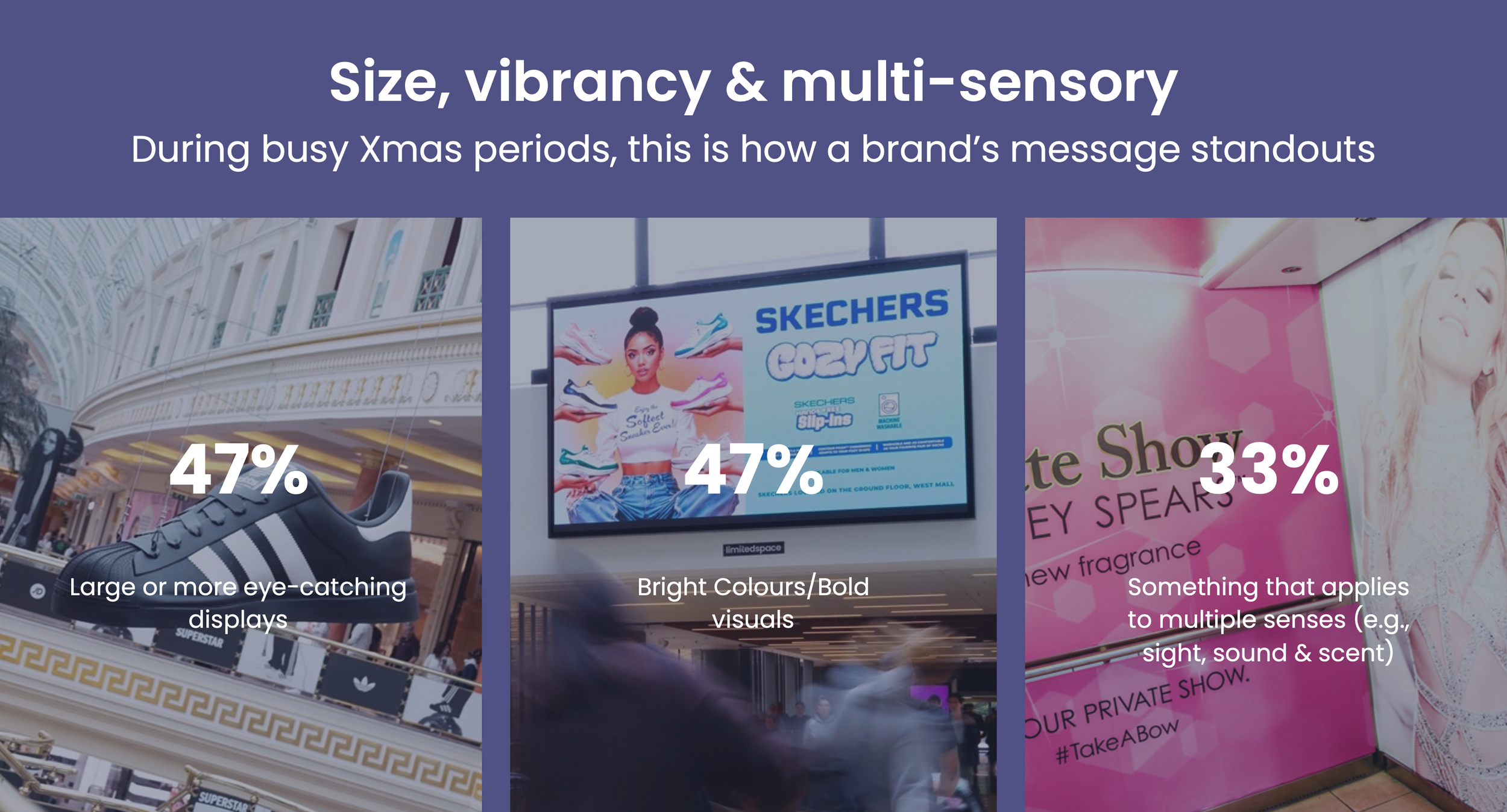
Our research shows that 47% of mallgoers agree that large or more eye-catching displays help a brand’s message stand out, while the same proportion respond to bright colours and bold visuals. A further 33% value something that appeals to multiple senses, such as sight, sound and scent.
When we asked what makes a brand memorable, the leading answer was interacting with or being able to experience the brand, at 38%, closely followed by seeing an advert in real life, at 36%.
Size also matters. Large digital screens are the format most likely to catch attention, with 42% agreeing that they stand out, followed by 3D decorations at 33% and large-format posters at 29%. Interactive screens and hanging banners both attract 28%, while 26% are drawn to immersive experiences.
The implication for advertisers is straightforward: Christmas is an opportunity to think beyond conventional media formats and plans - and create something that people notice, experience and remember.
Advertising can change how a brand is perceived
Perhaps most significantly, mall audiences appear to be particularly receptive to brand advertising.
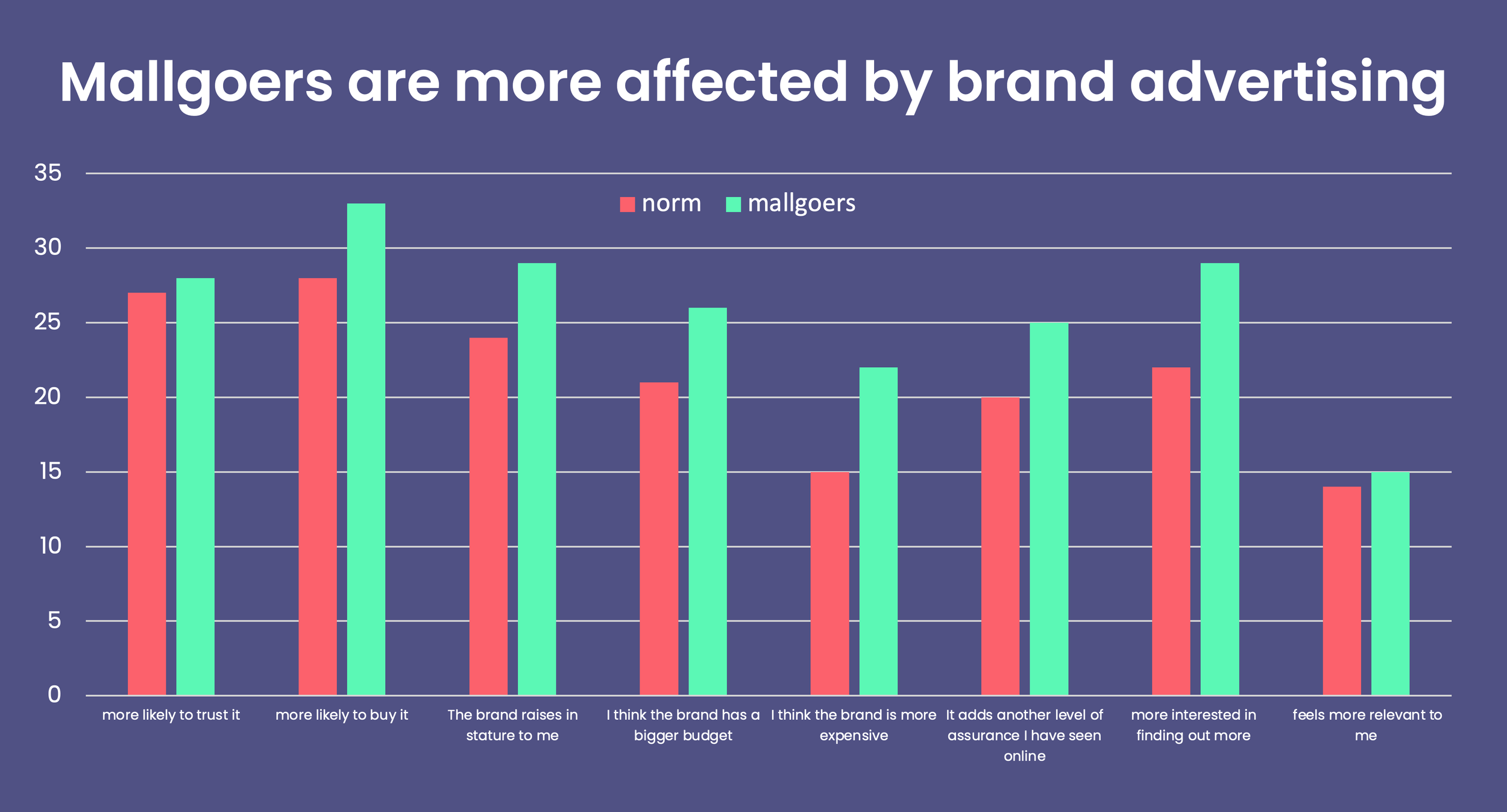
Compared with the wider norm, advertising among mallgoers delivers notable positive shifts in brand perception. There is a seven percentage point increase in the number who perceive the brand as more expensive, alongside a seven-point increase in those who are more interested in finding out more about the brand.
There are also five percentage point increases in those who are more likely to buy, believe the brand has greater stature, perceive it as having a bigger budget, and feel that advertising adds another level of assurance.
This suggests that the physical environment isn’t simply somewhere for brands to reach consumers. It can actively contribute to the way those brands are perceived.
Christmas doesn’t end on Christmas Day
One of the most interesting findings from our research is what happens after Christmas.
For mall audiences, Boxing Day is not the end of the Christmas journey. It is the beginning of another phase.
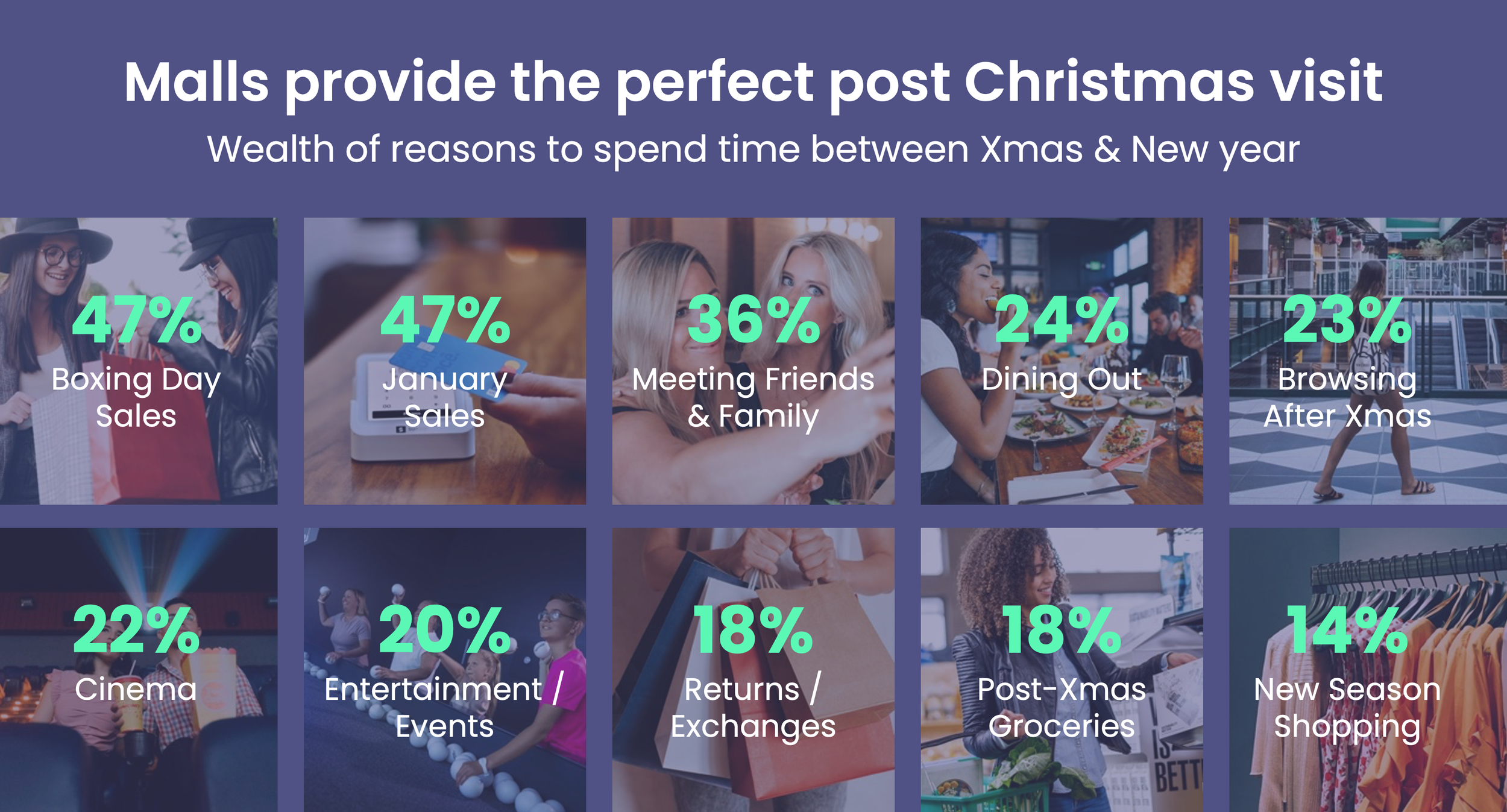
Almost half, 47%, plan to visit for Boxing Day sales, while the same proportion expect to visit for January sales. But sales are only part of the picture. Thirty-six per cent plan to meet friends and family, 24% expect to dine out and 23% will browse after Christmas.
Cinema attracts 22%, while 20% are interested in entertainment and events. Returns and exchanges and post-Christmas grocery shopping each account for 18%, while 14% are already thinking about new-season shopping.
Footfall and impressions
Our DataJam impression data provides a behavioural dimension to this picture, showing sustained growth towards Christmas, with November and December collectively delivering our busiest period of the year at +31%. This is followed by a strong Boxing Day and post-Christmas uplift and sustained January footfall.
The data shows a 21% increase in impressions around Boxing Day and the post-Christmas period. It also shows sustained momentum into January, with footfall remaining high until the second week of the month.
This is important because the post-Christmas period can sometimes be treated as a retail comedown. For mall audiences, it looks much more like a continuation.
The January opportunity extends beyond sales.
Mallgoers are more likely to act on New Year’s intentions, whether that means improving themselves, saving money or rewarding themselves.
Thirty-five per cent plan to focus on a healthier lifestyle, while they are 40% more likely than the norm to get a new gym membership.
Financial priorities are also prominent. A third, 33%, plan to organise their finances, while mallgoers are 37% more likely to get a new energy supplier.
And there is plenty of appetite for reward. Twenty-seven per cent plan to book a holiday, while mallgoers are 66% more likely to look to buy a new car.
The holiday opportunity is particularly significant. Around half of mallgoers will book a holiday during the first three months of the year.
The same is true of entertainment.
Forty-six per cent of mallgoers say they will look to add a new streaming service in the New Year, making them 31% more likely to do so than the norm. Meanwhile, 49% expect to watch more content during the winter months.
This underlines another important characteristic of mall audiences: their relationship with physical destinations exists alongside, rather than instead of, digital entertainment.
The mall can therefore play a role in a broader winter lifestyle, connecting retail with food, leisure, entertainment and experiences.
Overall, malls index strongly as an OOH environment that attracts, inspires and converts at a time of year that transcends the constraints of political or economic upheaval. Retail opportunities and leisure activities align under one roof to provide a one-stop shop for all things festive. So whether it’s searching for holiday inspiration, spending time with family and friends or simply grabbing that last minute gift, Yule be certain to find what you’re looking for.
Want to discuss this further? Please feel free to get in touch if you would like to talk to us about opportunities relating to anything mentioned above or any other queries.